
I’ve recently had a number of conversations with my students about the different types of moves in Go and why sente is seen as so valuable. As a result, I have put together this short and simple guide.
There are basically four categories of move: sente, gote, reverse sente and double sente
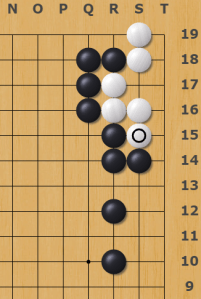
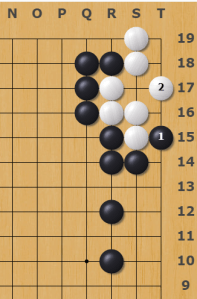
1. Sente : These moves threaten your opponent with a direct loss of points if they do not immediately answer your play. Notice that your opponent can always choose to accept the loss, and ignore your sente, depending on the size of the loss and what else is happening on the board.
If your opponent does answer, then their move is called gote, and you get to retain sente for another turn. If you look at Diagrams 1 and 2 you can see how T15 (1) is a strong sente move for Black. If White does not answer, then Black will play at T17 (2) and kill the White corner.
2. Gote: As we can see from the above, gote moves are the direct opposite of sente. They can occur in two situations.
a ) When we play a move in direct response to our opponent’s sente move and so they retain the initiative. White’s move in Diagram 2 (above) is a good example of this.
We also have to be careful, because what sometimes appears to be a sente move, actually ends in gote for us. You can see this in the three endgame diagrams below.
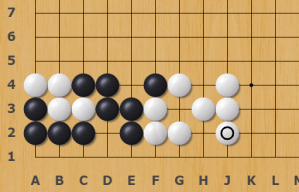
ends in gote for both players. These kinds of move
should always be played last.
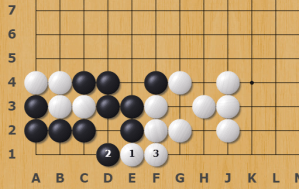
but the move ends in gote when white defends the E1 stone
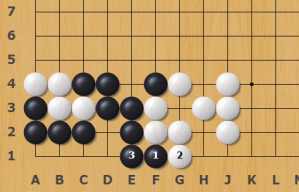
Notice how the difference between the two positions is two points.
b) We also call it gote, when we have sente, but choose to play a purely defensive move. In doing so, we hand our precious sente over to our opponent. (Although these gote plays can sometimes be described as reverse or preventative sente.)
3. Reverse Sente: This is the one that often confuses people. We can see from b) above, that a reverse sente move is actually a gote move; but is one that actually prevents our opponent from playing a powerful sente move against us. (A pure gote move does not contain this additional bonus)
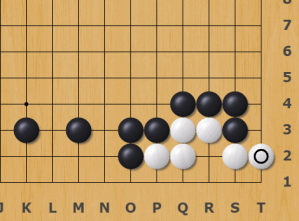
Because playing at P1 would be sente for Black, threatening to kill
the corner. The same move becomes a reverse (preventative) sente for White.
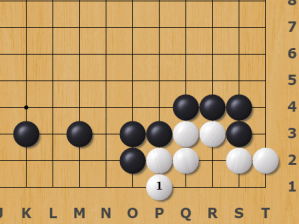
White plays at P1 in Gote. Because it prevents black’s move
and secures the corner. It is known as reverse (preventative) sente.
4. Double Sente: is a move that is sente for both players. These are the moves that we need to hunt down and play first in the endgame. They not only allow us to play first and retain sente, but they eliminate the possibility of opponent doing the same to us.
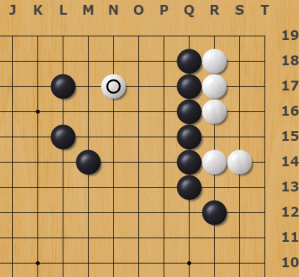
on the first line Q19 or R19 is sente for both players.

Black protects it stone by connecting at Q19, but then White
must also connect to prevent the atari in the corner. Black keeps sente.
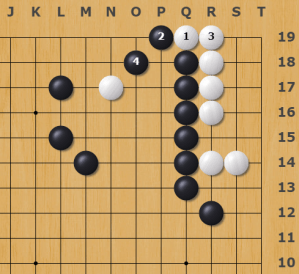
White connects at R19 to protect its stone but then Black must also make
a tiger mouth to protect his cutting point at P18. White retains sente.
And that’s it in a nutshell. I hope that these brief explanations were helpful. When you have sente in a game, try to anticipate how a move or sequence of moves will end, in either sente or gote for you. If the answer is gote, then look for another sequence that enables you to retain that precious initiative and the choice as to where the game goes next.
Have fun and see you across a goban soon.
 ten minutes to GO